Email Marketing for Luxury and Premium Brands: How to Communicate Exclusivity in Every Inbox
Luxury marketing is not only about showing an expensive product, but it is also about creating a feeling. When someone receives an email from a premium brand, the experience should feel different from an ordinary promotional email. While every brand is fighting for attention with big discounts and loud announcements, luxury brands have to do the opposite. They have to be calm, confident and exclusive. Although it’s true for every brand, it is especially true for email marketing for luxury brands in India.
The Indian luxury market has changed a lot in the last five years. Customers are no longer just in South Delhi or Mumbai. There are discerning customers in Hyderabad, Ahmedabad, Indore, Kochi and Ludhiana buying premium products and services. These customers travel, understand good quality and spend a lot of time online. So, when they receive an email, it should feel special. It should not look like just another advertisement.
But the question is: how can you write an email that feels like a personal invitation rather than a sales message? Let’s understand it in simple steps.
First, Understand What Luxury Means In an Inbox
For any brand, email marketing is all about getting more clicks, more sales and more urgency. But for a luxury brand, it is about the right feeling, relationship, exclusivity and the right timing. A premium customer does not want to feel like one of 10,000 people on a mailing list. They want to feel recognised. That’s why every email you send should feel private, as if it was created for one person only.
This is the foundation of a strong premium brand email strategy. With this, your email is less about selling a product and more about selling something personal. Understand it like this: a regular brand sells a handbag, but a luxury brand sells the story of who you become when you carry that handbag. So, your email has to carry that story.
Your Email List Should Feel Exclusive, Not Endless
Your email list is not a database. It is a guest list. A database needs to be huge, but a guest list needs to be the right one. What do you think about when it comes to a database? It is more technical. You store numbers, emails and data. So, you want your database to be as large as possible. It is only about the quantity. It doesn’t matter who’s inside it. But it's the opposite with a guest list. You don’t invite everyone randomly, but only invite the selected people. You know their name, preferences or what they like.
Most premium brands make a big mistake by having a huge database instead of having a guest list. Luxury brands do not want everyone; they want the right ones.
What Should You Do?
Instead of collecting emails from everywhere, collect them from genuine sources and with the right intention. In-store events, personal consultations and high-end partnerships. When someone shares their email with a luxury brand, it is a sign of trust.
Don't just segment your customers by age or city; segment them by taste and behaviour. For instance, consider:
- What they browse, such as classic pieces or the new collection.
- What is their budget? Are they looking at entry-level premium or top-tier couture?
- How do they engage? Do they always open emails but ignore discount emails?
All of these will tell you everything about them. A simple but powerful high-end email marketing tactic is to have three main segments: Prospect, Client and Patron. All three have different purposes and relationships with you. Thus, they shouldn’t get the same email.
Write a Subject Line That Feels Exclusive
You know how important the subject line of your email is. It must give recipients a reason to open the email. But it shouldn’t sound loud because a luxury brand would never have a loud salesperson at the door, and your subject line is your front door.
You must avoid these at all costs:
- “Flat 50% Off! Limited Time Only!”
- “Buy Now Before It’s Gone!”
- Too many emojis
What should luxury brands do instead?
Keep the subject line short, calm and intriguing. Make it personal and private so the customer feels it's written especially for them. Use language that suggests curation, not promotion.
For example,
- “First look: The collection we thought you’d love”
- “The Winter Edit, curated for you”
- “(Name), a closer look inside”
- “The piece we saved for you”
Keep Your Design Clean, Calm and Spacious
If you want to know how your luxury brand emails should look, then open a luxury brand’s email and a regular brand’s email side by side. You will see the difference instantly. A normal brand fills every inch, but a premium brand leaves space. Here are the rules for luxury email design:
- White space is your best friend: Don't be afraid of empty space. It creates a sense of calm, confidence and expense. Less is more for luxury brands. It tells the reader, “we don’t need to shout.”
- Show one product, not ten: Do not put all your 10 products in one email. Feature only one collection, one story, one masterpiece. If you are doing luxury email campaigns, each campaign should have a single focus.
- Use clean fonts and colour: Use clean, elegant fonts. Stick to your brand colour palette. If not, use black, white, beige, gold or deep jewel tones. Try to avoid bright colours like neon red or orange.
- Use only high-quality photos: Photos or images play an important role in email marketing for luxury or premium brands because they communicate the brand’s visual identity, quality and exclusivity. But never use low-quality images and generic stock photos because they will make your brand look less premium. A single professionally shot image is better than five generic pictures. The pictures you get clicked help you show texture and other details. You can show the stitch and fabric.
- Make it look good on mobile: Test your emails on mobile phones. In India, most people check their email on mobile phones. So, your email design should look even more beautiful on a small screen. Keep the text large enough to read and the buttons easy to tap but still elegant.
Write Like a Host, Not a Salesperson
It’s the major part where most brands lose their luxury feel. They use sales language, but premium brands should use hospitality language. Let’s make it clear for you.
- Don’t say this: “Shop our new collection now and get free shipping!”
- Say this instead: “The new collection is now available for your private viewing.”
For abandoned cart emails, don’t just say, “You left something in your cart. Complete your purchase!” Instead, say this: “We have kept your selection aside for you.” Using sophisticated words like curated, considered, crafted, private, invitation and complimentary carries a premium feel. And always personalise beyond just the first name. In luxury emails, how you say it matters more than what you sell.
Send Only These 7 Types of Emails
For a long-term premium brand email strategy, you need more than just new launch emails. Here are the seven types of emails that build exclusivity:
Welcome Email
When someone joins you, you should welcome them, but not by offering a discount. This can immediately make you a discount brand. Welcome them with your story. Who are you, what do you stand for and what does craftsmanship mean to you? Give them a beautiful collection preview. Make them feel they have joined a luxury brand.
Storytelling Email
Luxury is built on stories. Once a month, send an email that has nothing to do with selling. Tell them about the artisan who made the fabric, the inspiration behind your latest collection or the heritage of a technique. Your story about your brand or artisans builds emotional value that no discount can match.
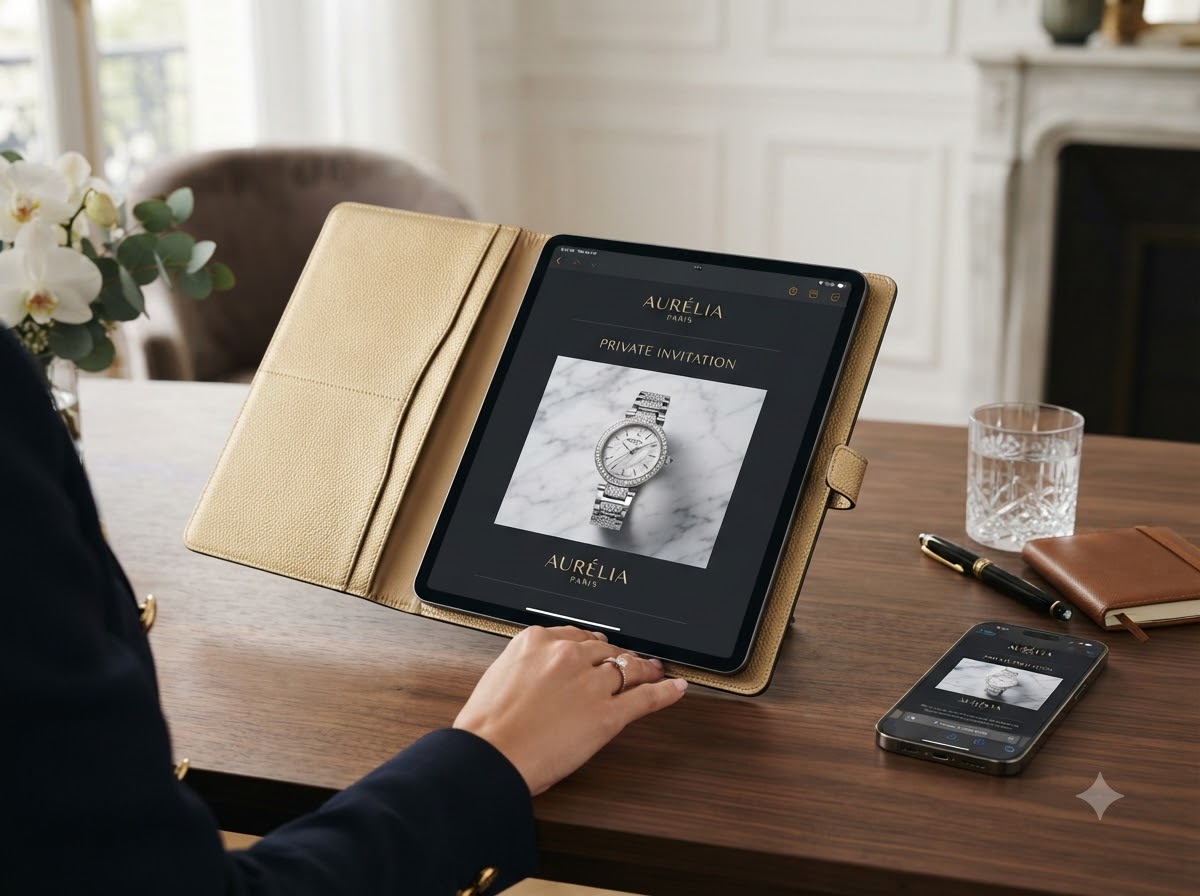
Private Invitation Email
It is the most important tool for every luxury brand for email marketing. You should make the email feel like an access pass, not a newsletter. This means you are inviting your client to something that is not open to everyone. It can be a store preview, a new collection launch or a one-on-one styling session. Luxury brands should use this because it makes the client feel chosen. And it changes the email from a promotion to a privilege.
Curation Email
Curation shows expertise. This email shows that you have done the hard work of choosing, so your customers don’t have to. Instead of showing your whole catalogue, show a small, handpicked collection. It can be a seasonal edit, an editor’s pick or a stylist’s choice. Brands should use this because it saves clients time and also shows your expertise. It feels like advice from a trusted stylist, not like a regular shop page.
Aftercare Email
For a premium brand, the sale is not the end. In fact, it’s the beginning of establishing a strong relationship with your customers. Send an email with instructions on how to care for the product, how to store it and how to style it in different ways. This shows respect for the purchase and for the customer. It proves that you are not here only to sell, but you respect the client’s investment. Regular brands ask for a review after a sale, but luxury brands offer service even after a sale.
Product Reminder Email
After a few days or weeks, you should send a gentle reminder. For example, “We noticed your fragrance may be running low. Shall we reserve your next bottle?” This email is helpful, not pushy. You should use this because it feels like a personal assistant remembering things for the client. It is a service, not a sales push.
Re-engagement Email
If a valuable client has not opened your emails in a while, don’t chase them like a regular brand does: “We miss you! Here’s 20% Off!” Instead, give them control. For example, “Shall we pause for a while? Or would you prefer to hear from us less often?” This email is respectful, not desperate.
This is exactly what differs a premium brand from a regular company. It’s important because, for a luxury brand, giving the client a choice is more powerful than giving a discount.
Email Less Often Than You Think
Be rare, not regular. A regular brand might send 3-4 emails a week. A luxury brand should not. If you email too often, you become noise, and a luxury brand can never be noise.
For most premium brands in India, 2-4 highly crafted emails per month is more than enough. For top-tier luxury, even 1-2 per month is fine if the quality is exceptional. Besides, you should think about timing. Do not send emails at the same time as everyone else. Test elegant timings like Sunday morning, Wednesday afternoon or Friday evening when people plan their weekend.
When you send less often, your audience is not rushing to clear their inbox. This scarcity creates desire, which is an important part of a successful luxury email campaign.
Make Privacy Part of Your Luxury Promise
You are a luxury brand, so your customers are premium too. They are very much aware of their privacy, and they don’t want their data sold, behaviour tracked openly or to feel spied on.
You should be transparent. Tell your customers why you are asking for their preferences. Give them an easy way to update what they want to hear about. And never use any overly personal lines like “We saw you looking at this item 5 times yesterday!” Instead, be polite and say, “Still thinking about it? It’s waiting in your private selection.”
In India, with increasing awareness about data privacy, this respectful approach builds huge trust, which is valuable for high-end email marketing.
Measure Relationships, Not Just Clicks
Most brands only focus on clicks and sales. But for a luxury brand, the real measure is relationships. You should not just check open rate and click rate but also see who is actually replying to your emails because a reply means they feel a connection with you. You also need to see how many customers your email is bringing to the store, not just website visits.
Another important thing is to check if your best clients are staying with you. In luxury, one client who buys one expensive piece and stays with you for five years is far more valuable than ten people who only buy during a sale.
Check If Your Email Feels Premium Before You Send
Before you send any email, pause and check whether it actually feels premium. The best way is to ask yourself if you would send this email to a guest. If it feels too loud or like a sales pitch, you should not send it. A premium email should always have one focus, which includes one story, one product or one invitation.
Also, it should feel private, like it was written only for that one reader. Keep the language calm; no hurry or extra emojis. The image should also be beautiful because one high-quality photo is always better than five average ones. If your email fails any of these checks, you should edit it again. A luxury email should never be created in a hurry.
Conclusion
Good luxury email marketing is not about sending more emails; it is about maintaining exclusivity. When every email feels like a private invitation rather than promotional, your clients feel special and chosen. That feeling of exclusivity is what turns a simple email into a long-term luxury relationship.
Ready to send campaigns that convert?
Try ASP OL Media free for 14 days — no credit card required.