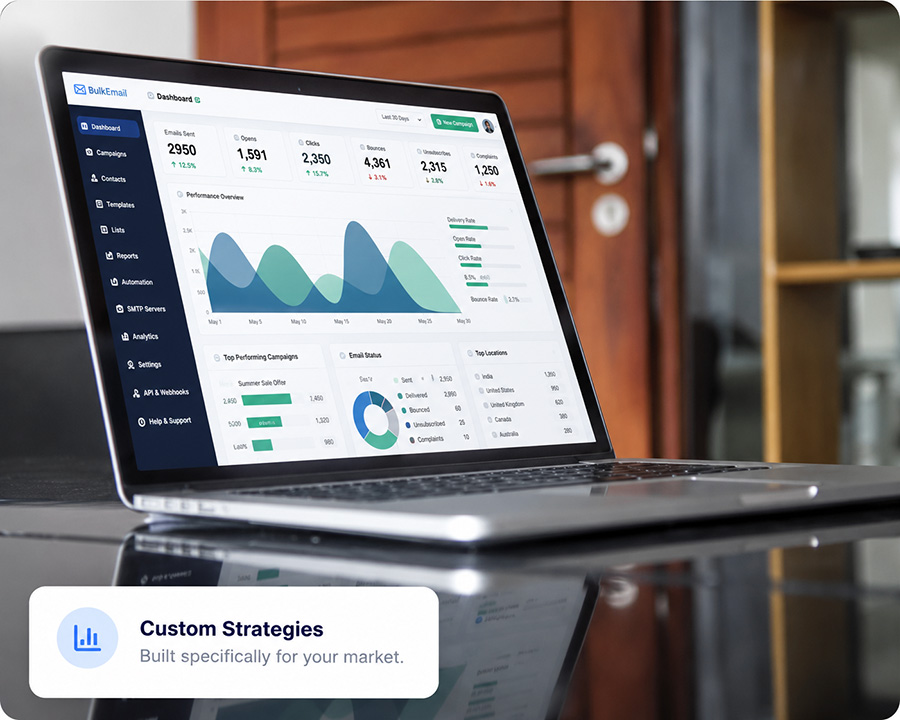
A generic email strategy won’t deliver the result you need. Whether you are driving e-commerce sales, nurturing B2B software leads or managing patient communications, we create bulk email strategies specifically for your industry.
Email Marketing CampaignsBulk Email ServicesSMTP Server with IP RotationEmail AutomationEmail Deliverability ManagementAnalytics and ReportingEmail List Management and GrowthEmail Design and Content Creation
Why One-Size-Fits-All Doesn’t Work
Each industry has a different approach to email marketing. The sales cycle, customer expectations, compliance requirements and even email management habits can change dramatically depending on the business.
Compliance Is Important
Industries such as healthcare and finance have rigorous privacy and security requirements that generic bulk email configurations often struggle to manage effectively.
Sales Cycles Vary
SaaS and real estate companies generally need long-term lead nurturing, while e-commerce and restaurants rely on fast promotions and limited-time offers.
Audiences Act Differently
An executive at a manufacturing company checks email differently than someone who is planning a vacation. Audience alignment is key for subject lines, timing and messaging.
Our Expertise
Industries We Empower
Pick your industry below and discover how our high-volume bulk email infrastructure and strategic campaigns can grow your specific business model.
We don’t just give you an SMTP service; we give you a full marketing engine, built to industry standards to ensure you get maximum deliverability.
Enterprise Deliverability
Strict SPF, DKIM and DMARC authentication paired with continuous IP reputation management ensures your emails hit the primary inbox, not the spam folder.
Audience Segmentation
Even when sending in bulk, we segment your lists based on demographics and behaviour to ensure the highest possible relevance and engagement rates.
Transparent Analytics
Track your industry campaigns in real-time. We provide detailed reporting on opens, clicks, bounces and conversions to continually optimise your strategy.
Why Industry Context Shapes Every Bulk Email Decision
Bulk email marketing is the intersection of technology, strategy and market psychology. The technical infrastructure is pretty much the same across industries, but everything built on top of that infrastructure varies wildly depending on what you sell, who you sell to and how your market behaves.
A retailer sending flash sale alerts needs immediate opens and fast conversions. The email lands in the inbox, the recipient acts in minutes, and the transaction is complete in hours. In contrast, a B2B software company that nurtures enterprise leads works on a whole different timeline. Their emails could be opened days later, forwarded to other team members, read by multiple stakeholders and ultimately result in a purchase decision six months later. Both use the same infrastructure, but everything else about how they work is different.
Regulatory environments complicate matters even further. HIPAA places restrictions on healthcare providers regarding how they may share patient information. Financial services firms are also subject to securities laws and consumer protection laws that regulate promotional communications. E-commerce retailers also face regional compliance requirements around consumer rights and data protection. FERPA must be followed by educational institutions in communications with students and parents. These are not trivial concerns. These are the fundamental constraints that govern list management, content strategy and operational workflows.
Expectations of industry customers vary widely. Someone who signs up to a fashion retailer’s email list expects regular communication. Daily emails are not just acceptable. They’re often welcomed. That frequency for a B2B consulting firm would destroy sender reputation and engagement metrics. The context sets the cadence, and if you get the cadence wrong, then everything else you do suffers.
E-Commerce and Retail: Speed, Frequency and Transactional Focus
E-commerce bulk email marketing is all about speed and time. It lives in the immediate because promotional windows are measured in hours, not days. A weekend sale, a limited-time discount code, and a cart abandonment email triggered 30 minutes after someone leaves your site are typical e-commerce campaigns that depend on speed and precise timing, often pushing the timing capabilities of standard email platforms to the limit.
The operational challenges are real because of volume fluctuations. On a Tuesday, an e-commerce brand might send 100,000 emails, and on Black Friday, two million. That volume spike can overload shared infrastructure and cause ISP throttling if your sending reputation is not rock solid. When retailers have seasonal or promotional spikes, dedicated bulk email infrastructure with pre-warmed IPs and scalable SMTP capacity is essential.
Transactional emails blur the line between bulk and triggered emails. While order confirmations, shipping notifications and delivery updates may not be “marketing emails” in the traditional sense, they still count toward your bulk-sending volume. They require guaranteed delivery and near-instant processing and are typically exempt from unsubscribe requirements because they are transactional, not promotional. These two streams have technical and compliance differences that are important to manage for e-commerce operations.
Product recommendation algorithms drive a large proportion of revenue generated by e-commerce emails. They are not just easy broadcast campaigns. They are customised, dynamic emails that draw from product catalogues, browsing history, and purchase patterns. Delivering millions of personalised recommendation emails every day requires infrastructure that can process complex data quickly while maintaining deliverability.
In e-commerce, segmentation is often based on purchasing behaviour and lifecycle stage. Examples include:
A welcome series and first-purchase nurturing for new customers.
Loyalty rewards and exclusive previews for repeat customers.
Win-back campaigns for inactive customers.
VIP treatment and early access to sales for high-value clients.
These segments are not immutable. Someone moves from new customer to repeat customer to dormant depending on their behaviour, which means your bulk email system needs to integrate tightly with your e-commerce platform and update segments in real time.
B2B and SaaS: Longer Sales Cycles & Multi-Touch Attribution
The economics of B2B bulk email marketing are fundamentally different from B2C. You’re not interested in thousands of small transactions. You’re nurturing hundreds or thousands of leads to high-value contracts. One converted lead could be $50,000 or $500,000 in annual recurring revenue, and that changes how you think about email strategy, content investment and campaign measurement.
Sales cycles can last months or years. A lead enters your database through a whitepaper download, gets three months of educational content, attends a webinar, gets assigned a sales rep, reviews case studies and ROI calculators, participates in a product demo, brings in procurement and legal teams and closes a deal nine months after the initial opt-in. Your bulk email infrastructure must support that level of complexity, with long-running nurture sequences, lead scoring integration, sales handoff triggers and attribution tracking across dozens of touchpoints.
The quality of the lead is far more important than the quantity of leads. Bulk email isn’t how B2B marketers achieve maximum reach. It’s about delivering the right content to the right decision-maker at the right point in their buying journey. A list of 10,000 qualified prospects is worth more than a list of 100,000 cold contacts, and that changes the focus from pure throughput to precise targeting and relevant content.
B2B email deliverability has its own challenges. You frequently email corporate addresses protected by aggressive spam filters and email security gateways. Microsoft 365 and Google Workspace employ advanced filtering that surpasses typical ISP spam detection. Your emails must be technically perfect in authentication, have a good sender reputation and not trigger corporate security filters. If you’re a bulk sender in the B2B space, sloppy list hygiene or poor engagement metrics are not an option. The cost of landing in spam is measured in lost pipeline, not just wasted sends.
Multi-channel coordination at scale also becomes critical. Your bulk email campaigns are not in a vacuum. They are aligned to LinkedIn ads, retargeting initiatives, webinar marketing and direct sales outreach. If you are sending millions of emails as part of a larger account-based marketing strategy, you need your email infrastructure to integrate with your marketing automation platform, CRM and analytics stack to keep messaging consistent and avoid awkward overlaps.
Healthcare and Medical: Compliance, Privacy & Patient Communication
It’s all about HIPAA when it comes to healthcare email marketing. Emails containing protected health information (PHI) are subject to strict HIPAA privacy and security requirements. Even bulk promotional emails like health tips and clinic newsletters, as well as operational emails such as appointment reminders, need to be handled carefully to avoid compliance violations that could result in significant fines and legal exposure.
Patient communication is different from a regular marketing email. You are not only selling services. You are providing continuity of care, appointment management and health education. The stakes are much higher. A missed appointment reminder could mean a delayed diagnosis. A promotional email sent at the wrong time can be offensive to someone dealing with a health crisis. Sensitivity and accuracy are far more important than volume or conversion rates.
Consent management in healthcare is also more complicated than standard marketing opt-ins. Patients can choose to receive appointment reminders but not promotional emails. They might let you send general health advice but not specific treatment promotions. Respecting those distinctions is not only good practice but it is also a legal requirement. For your bulk mail infrastructure, you need a good preference management solution that integrates with your patient management system.
Emergency and urgent communications require guaranteed and speedy delivery. Clinics may need to notify patients about appointment cancellations, changes to vaccine availability or public health alerts. These emails must never be delayed by volume caps or queue backlogs. Healthcare bulk email infrastructure requires prioritisation capabilities that ensure urgent messages are delivered immediately and routine communications are delivered on a normal schedule.
Education: Event-Driven Campaigns & Community Engagement
Educational institutions need email communications for marketing, operations, and community management. Universities send admissions campaigns to prospective students, event notices to current students, fundraising appeals to alumni, and emergency alerts to the entire campus community. These various use cases demand a flexible bulk email infrastructure capable of supporting everything from promotional nurturing to mission-critical emergency notifications.
Admissions marketing has hard deadlines tied to application cycles, decision dates, and enrolment deadlines. Over several months, a university might send millions of emails to prospective students and then cut back sharply once the admissions cycle is over. This seasonal pattern creates the same infrastructure challenges that e-commerce brands face during holiday peaks, namely the need for scalable capacity that can scale up and down without maintaining expensive dedicated resources during off-seasons.
Student lifecycle communications are continuous and highly segmented. Prospective students get one message, accepted students get another, enrolled students get another, and graduating seniors get another. They then move to alumni lists, which have totally different messaging. To manage these lifecycle segments at scale, bulk email infrastructure must integrate with student information systems and automatically update segments as students progress.
Alumni engagement has its own challenges. Alumni lists are large, geographically dispersed, and span decades of graduating classes. Email addresses change frequently as alumni move on to new jobs and as personal circumstances change. To maintain list quality across such a diverse and changing population, your infrastructure needs strict list hygiene, multiple touchpoints to capture updated contact information, and segmentation strategies that reflect the varying levels of engagement across different alumni cohorts.
Travel & Hospitality: Seasonal Peaks and Experience Marketing
Travel and hospitality marketing is about urgency and aspiration. Last-minute deals, limited availability, exclusive offers, and destination inspiration all play on emotion and timing to drive bookings. Travel brands’ bulk email infrastructure must support the operational rhythm of booking confirmations and cancellation notices as well as the marketing rhythm of promotional campaigns associated with seasons, holidays, and booking windows.
Seasonal travel volume swings are dramatic. A beach resort might send ten times more emails during the winter planning season than it does in the off-season months. Airlines receive enormous quantities of email during times of year when people are planning travel for the holidays. Hotels run campaigns during peak booking windows and scale down during slow times. This seasonality demands infrastructure capable of handling peak loads without incurring fixed costs during periods of low volume.
Loyalty programmes alone generate massive email volume. Points balances and tier status updates, exclusive member offers, and bonus point opportunities all drive repeat bookings and customer lifetime value. Loyalty email strategies require tight integration with reservation systems and rewards platforms. Bulk email infrastructure must have strong API connectivity and real-time data synchronisation.
Real Estate: Long Cycles and Relationship Nurturing
Real estate marketing has some of the longest decision cycles of any consumer marketing. Someone might enter your database years before they are ready to buy or sell. Your bulk email campaigns are not bringing in immediate conversions. They’re building relationships, demonstrating expertise, and keeping your business in a prospect’s thoughts until they’re ready to act.
Geographic targeting is a must. A buyer looking at downtown condos has no interest in suburban single-family home listings. A seller in a neighbourhood doesn’t care about market trends for the city as a whole. Granular geographic segmentation based on property data, neighbourhood boundaries, and subscriber preferences is needed in real estate bulk email strategies. At scale, that means integrating email infrastructure with MLS feeds, property databases, and CRM systems that track geographic interests.
Email engagement lead scoring helps prioritise sales follow-up. You may manage thousands of leads across multi-year timelines, so you need signals that tell you when someone is moving from passive interest to active search. Email engagement metrics provide those signals, and bulk email infrastructure for real estate needs to integrate with CRM lead scoring models so high-intent prospects get routed to sales teams quickly.
Financial Services: Trust, Compliance, and Risk Management
Regulatory bodies are very strict when it comes to financial services email marketing. Securities laws, consumer protection rules, and fiduciary standards all regulate how financial institutions may communicate with clients and prospects. Compliance features need to be built into bulk email infrastructure for financial services, not added as an afterthought.
Trust is the currency that makes financial email marketing possible. A bank, investment firm, or insurance company that sends out poorly targeted, aggressive emails can damage the trust relationship that underpins its entire business. Relevance and restraint are key for financial services bulk email strategies, not aggressive conversion tactics or volume maximisation.
Fraud prevention in this industry becomes an email deliverability issue. Phishing attacks against financial institutions are common, and ISPs and email security gateways are particularly sensitive to emails related to financial services. Even legitimate bulk campaigns from banks or investment firms are subject to more stringent filtering. A strong sender reputation, proper technical authentication, and domain protection measures such as DMARC are essential for financial institutions to prevent domain spoofing that can be exploited for phishing attacks.
Client lifecycle communication in financial services has a long history. Relationships can last a lifetime, from a first current account opened in college to retirement planning years later. The email nurture cycle here is not months. It’s years. Bulk email infrastructure needs to support these long relationship timelines with lifecycle segmentation, automated triggers based on life events, and the ability to maintain engagement over extended time spans.
Start Today
Ready to Supercharge Your Email Marketing?
Join 10,000+ Indian businesses using ASP OL Media to reach more customers, drive more sales, and grow faster.
14-day free trial . No credit card . Cancel anytime