Email Marketing Campaigns
Email Marketing Analytics and Reporting
Track opens, clicks, and conversions with advanced analytics and reporting tools. Optimise email performance and maximise ROI with data-driven insights.
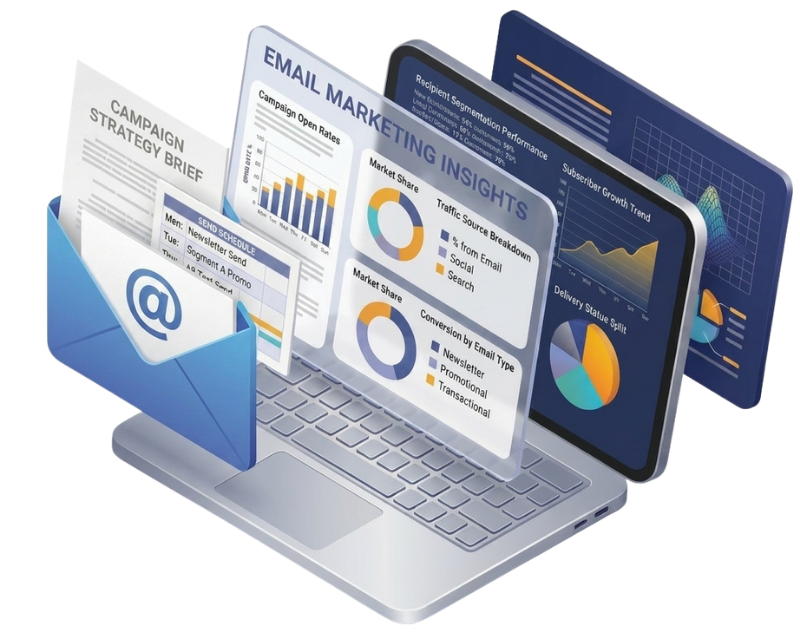
Track opens, clicks, and conversions with advanced analytics and reporting tools. Optimise email performance and maximise ROI with data-driven insights.

Sending an email campaign is only one part of the job. The more useful question comes after the send: What happened?
How many people engaged with your message? Which links attracted their attention? Did the campaign generate leads or sales? Did one audience respond better than another? Was the poor result caused by the email itself, the offer, the landing page or deliverability?
ASP OL Media provides email marketing analytics and reporting services that help answer these questions with campaign data. We track the metrics that matter, compare performance over time, analyse subscriber behaviour and turn the findings into practical recommendations.
The aim is simple. You should know what your email marketing is doing and have enough information to decide what to change next.

Open rates are easy to find, so they often become the main number in an email report. That can create a misleading picture.
Suppose an email gets a strong open rate but very few clicks. The subject line may have done its job, while the content, offer or call to action failed to move people forward.
The opposite can happen too. An email may have an average open rate but generate a good number of qualified enquiries. Judging that campaign only by opens would miss the result that matters most.
We examine email performance as a connected set of signals. Opens can help assess both subject line performance and sender recognition. Clicks show whether the message gives people a reason to act. Conversions connect email engagement with a business outcome. Revenue data can show whether campaigns are producing measurable commercial value.
We also account for the limitations of individual metrics. Open tracking, for example, has become less precise because of privacy features such as Apple Mail Privacy Protection. That makes it even more important to read open data alongside clicks, conversions, delivery data and other behavioural signals.
Open rate helps us understand how subscribers respond to the sender name and subject line. We compare it with previous campaigns rather than treating one percentage as a final judgement. A decline may point towards weaker subject lines, changes in audience quality, changes in sending frequency or deliverability issues. We investigate the surrounding data before deciding what needs attention.
Clicks show whether subscribers found something in the email worth pursuing. We analyse the overall click-through rate, as well as individual links, where available tracking supports it. This can reveal whether people are responding to the primary call to action or showing more interest in another part of the message.
Clicks matter because they can lead to a business action, such as a purchase, form submission, registration, booking, download or enquiry. Conversion reporting helps distinguish campaigns that attract attention from those that move prospects toward a business goal. If clicks are high but conversions remain low, the landing page, offer, pricing, form or checkout may need attention.
We track hard and soft bounces to see how many emails bounce back as undeliverable to recipients. Hard bounces typically mean that the email address is invalid or no longer in existence. Soft bounces can be caused by temporary delivery issues. Monitoring bounce rates can also help identify list quality and deliverability issues.
Unsubscribes provide useful information about audience response. A small number of unsubscribes is normal. A sudden increase deserves investigation. The campaign may have been sent too frequently, the content may have lacked relevance, or the audience may have been poorly targeted.
Spam complaints can affect your sender reputation and future inbox placement. We monitor complaint data alongside engagement and delivery metrics so potential problems aren’t buried in a general campaign report.
A growing subscriber count doesn’t automatically mean your database is becoming healthier. We look at new subscribers alongside unsubscribes and bounces. This gives you a clearer view of net list growth and helps identify whether acquisition is adding engaged contacts or simply increasing the size of a low-response database.
For campaigns tied to sales data, revenue reporting links email activity with commercial results. Revenue per email can also provide a useful way to compare campaigns with different send volumes. Where the tracking setup permits it, we can also examine direct and assisted conversions to understand email’s role in the customer journey.
Subscriber behaviour can change after someone joins a list. New subscribers may respond strongly at first and become less active later. Other subscribers may become more engaged after receiving relevant content over several weeks or months. Cohort and engagement analysis can reveal these patterns and help you decide when to segment, re-engage or remove inactive contacts.

A campaign report should help you understand what happened after a specific send. We review the main performance indicators, compare them with previous results, and determine areas that need attention. A campaign that performs below your normal range needs a different response from a campaign that simply attracts a smaller audience.
The report can also examine specific campaign elements. A subject line variation may increase open rates. A particular link may receive most of the clicks. A segment may show strong engagement yet weak conversions.
These details help us move from a percentage on a dashboard to a reason for the result.
Individual campaigns tell you what happened on one occasion. Monthly reporting helps you see patterns.
We consolidate campaign performance to identify changes in engagement, conversions, revenue, list growth and delivery. We can also compare different campaign types.
For example, your promotional campaigns may generate more immediate sales while your newsletters produce stronger engagement. An automated sequence may convert better than one-off broadcasts. Those differences may affect where you spend time and budget.
Monthly reporting also helps to identify gradual shifts. A single campaign with fewer clicks can’t tell you much. A steady decline over several weeks deserves closer attention.
Your subscriber database contains people with different interests, needs and levels of engagement. Treating the entire list as one audience can hide useful patterns.
We analyse performance among relevant segments to identify where engagement and conversions are strongest.
A segment with high clicks but low conversions may understand the offer but need a different proposition. Another segment with low engagement may need different content or a re-engagement campaign. A highly engaged group could be suitable for a more focused offer.
Segment reporting gives you a clearer basis for deciding who should receive what kind of communication.
We record the results and analysis behind every Email A/B test we do. Which variation won, by how much, and what that means for your audience. We collect data from tests over time to build a knowledge base of what works for your specific subscribers.
Testing only becomes useful when the results influence later campaigns. We analyse the performance of email A/B tests and record what changed between variations. Depending on the test, this may involve subject lines, content, calls to action, layouts or other campaign elements.
The purpose isn’t to declare a winner and move on. We look for patterns throughout tests.
If one subject line approach repeatedly outperforms another, that finding can direct future copy. If a particular layout consistently receives more clicks, the design team can use that information in later emails.
We also keep the testing method controlled. When possible, testing one meaningful variable at a time makes the result easier to interpret.
Email marketing often adds to a sale without being the only touchpoint. A customer might receive a promotional email, visit the website, return through another channel and purchase later. A lead may click a nurturing email several times before contacting the sales team.
Our reporting can use attribution approaches such as first-touch and last-touch attribution, with multi-touch analysis where the available data and tracking setup support it.
The purpose is to give you a more useful view of email’s contribution. You can then assess campaigns based on their role in the customer journey instead of relying only on immediate clicks.

A report has limited value if nobody knows what to do with it. We use the data to identify practical changes that can be tested in future campaigns.
Performance data can reveal differences between days and times. We compare your audience’s behaviour across sends rather than relying on a generic recommendation about the "best" time to send an email. B2B and B2C audiences can behave differently. Your own historical data is usually more useful than a universal schedule.
Subject line performance can reveal which approaches attract your subscribers. We can compare questions with statements, direct offers with benefit-led wording or shorter subjects with longer ones when your testing data supports those comparisons. The important point is to use your own audience’s response as evidence.
Click data can show if subscribers are responding to the main offer, supporting content, images, text links or other elements. If the main CTA gets little attention and another link gets most clicks, that tells us something about the message. The next campaign might require a more concrete hierarchy or a better connection between the email copy and the desired action.
If a particular audience repeatedly shows low engagement, we investigate before continuing to send the same content. The solution could involve better targeting, different messaging, a re-engagement campaign or removal of persistently inactive contacts.
Analytics can also reveal problems that aren’t caused by creative performance. A rise in bounces, falling engagement or changes in complaint rates may point towards list quality or deliverability concerns. Looking at these signals together helps separate an inbox placement issue from a copy or offer problem.
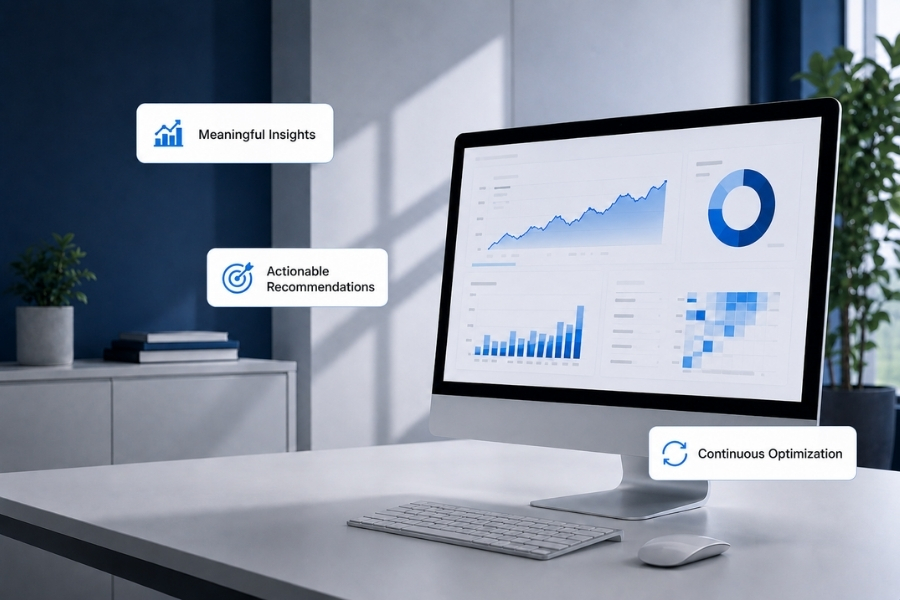
Our analytics and reporting service focuses on interpretation as well as measurement. You can expect reporting around the metrics relevant to your email programme, with comparisons that make the numbers easier to understand. We identify meaningful changes rather than filling reports with every available statistic.
We also explain what the data suggests you should test or change. That makes a difference. A spreadsheet may show you that your click-through rate dropped from one campaign to the next. Useful analysis asks why it fell and what evidence supports the possible explanation.
The same approach applies when performance improves. We look for the campaign elements or audience conditions that may have contributed to the result so that successful patterns can be tested again.
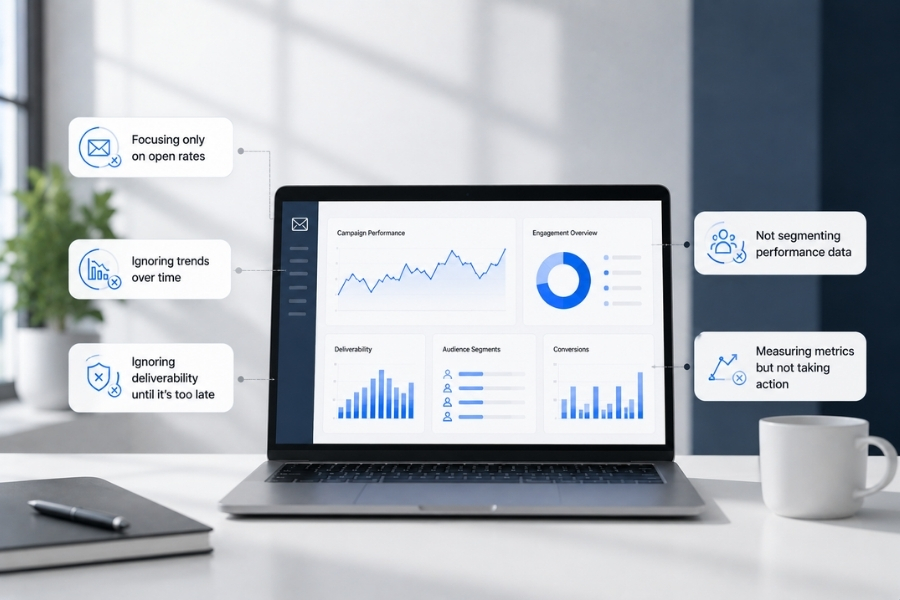
Businesses often collect plenty of email data without building a useful reporting process around it.
One common problem is focusing almost entirely on open rates. Another is reviewing each campaign separately without comparing results over time. Some reports also combine all subscribers into a single audience, making it difficult to see which segments actually respond.
Revenue can create another reporting gap. If email activity isn’t connected properly with website, e-commerce or CRM data, you may see engagement without knowing what happened afterwards.
We address these gaps by reviewing the complete reporting setup and establishing metrics that align with your objectives.

We proceed by reviewing your current email marketing setup and the data available from your email platform, website, e-commerce system or CRM.
Next, we identify tracking gaps and establish the baseline metrics needed for future comparison. This gives us a clear starting point instead of judging performance against arbitrary numbers.
Once the reporting structure is in place, we monitor campaign performance and analyse the results. We compare current data with historical performance and examine relevant segments, campaign types and conversion activity.
The findings then feed into recommendations for future campaigns.
As your email programme produces more data, the analysis becomes more useful. We can compare campaigns over longer periods, detect recurring patterns, evaluate tests and refine the reporting around the metrics that matter most to your business.
Your email platform already produces a large amount of data. The challenge is deciding which numbers deserve attention and what those numbers mean for your next campaign.
ASP OL Media helps you turn that data into a working feedback loop. Campaigns generate results. Results reveal patterns. Those patterns inform the next round of campaigns.
If you’re spending money on email marketing, you should be able to see where that money is going and what the campaigns are producing.
Request an email audit from ASP OL Media and get a clearer view of your email marketing performance.