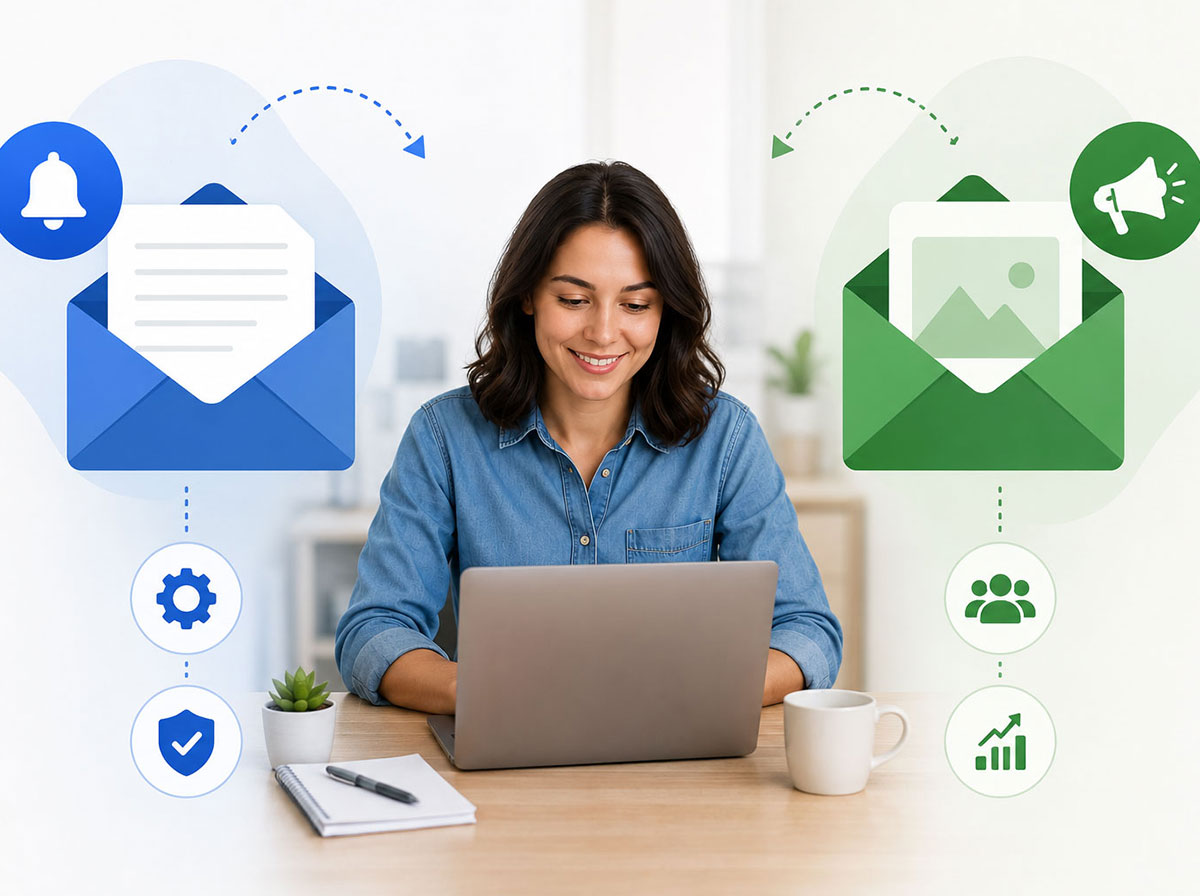
How SaaS Companies Should Use Transactional and Marketing Emails
Email remains one of the most effective communication channels for SaaS (Software as a Service) businesses. Email plays a vital role in shaping the customer experience, whether you’re welcoming a new user, resetting a password, announcing a product update or promoting a new feature.
However, several SaaS companies make the mistake of treating all emails the same way. In fact, business emails are broadly categorised into two types: marketing emails and transactional emails. Understanding the difference between the two is required for enhancing customer engagement, increasing conversion rates, maintaining compliance and guaranteeing email deliverability.
If you ever thought about how some emails achieve higher open rates while others struggle to get even noticed, the answer lies in understanding the reasons for and execution of both email types.
In this blog post, we will discuss both email types, break down the differences between them, look into real-world SaaS examples and demonstrate how to use both effectively and efficiently to drive business growth.
What are Transactional Emails?
Transactional emails are one-to-one, automated messages delivered to users after they complete a specific action or transaction. These emails deliver the necessary information that a user may expect or often require at the moment to complete the workflow, such as a purchase or an account registration.
These emails are not designed to sell products or services like promotional emails. Their primary goal is to assist the user’s interaction with your platform.
Common Examples of Transactional Emails
- Account verification emails
- Welcome emails
- Password reset emails
- Login alerts
- Subscription confirmations
- Payment receipts
- Invoice notifications
- Trial expiry reminders
- Security notifications
- Product usage confirmations
For instance, when a user registers or signs up for a SaaS platform, they receive a verification link at their registered email address. That’s a transactional email.
Similarly, when a customer receives a payment receipt after upgrading their subscription, that is also a transactional email.
Why are Transactional Emails Important?
These emails are important because they directly affect or influence customer trust, operational efficiency and business revenue. Because recipients are eagerly waiting for these messages, they are more likely to open them. Therefore, the open rates of transactional emails are higher than traditional emails. These are considered the backbone of customer communication, as they provide information users eagerly expect.
These emails commonly achieve:
- Higher open rates
- Better engagement
- Greater trust
- Improved customer experience
- Stronger brand credibility
What are Marketing Emails?
A marketing email is a strategic promotional communication sent to a list of subscribers to nurture leads, engage customers and promote a product, service or brand. The primary goal of marketing emails is to drive business growth by influencing customer behaviour. Unlike transactional emails, which are caused by user action, marketing emails are set in motion by businesses to draw customer engagement, conversions and generate more revenue.
These emails are generally delivered to a broader audience and concentrate on promoting products and services, features, content or offers.
Common Examples of Marketing Emails
- Product announcements
- Feature launch campaigns
- Promotional offers
- Discount campaigns
- Newsletter updates
- Customer success stories
- Webinar invitations
- Free trial promotions
- Upselling campaigns
- Re-engagement emails
For example, if a SaaS (software as a service) company launches a new AI-enabled feature and sends an email to customers to motivate them to use it, then we call it a marketing email.
Why Are Marketing Emails Important?
Marketing emails are crucial because they provide businesses with a direct, reliable, owned communication channel with customers, develop brand trust and generate measurable revenue. There is no need to rely on changing social media algorithms or any third-party algorithm shifts to reach your audience because marketing emails allow you to control the list. The direct connection with customers makes marketing emails remarkably effective at driving measurable revenue, frequently delivering one of the highest ROI (return on investment) among all marketing channels.
Marketing emails let brands send direct, highly personalised content to their customers based on their specific preferences, purchase history and behaviour. With consistent, timely reminders, educational newsletters and targeted promotions, businesses develop long-term relationships with customers.
Marketing emails help businesses to:
- Generate leads
- Increase product adoption
- Boost conversions
- Improve customer retention
- Drive revenue growth
- Build stronger customer relationships, etc.
A well-strategised marketing email keeps the customer informed throughout their journey.
Key Differences: Transactional Emails vs Marketing Emails
| Features | Transactional Emails | Marketing Emails |
| Purpose | Provide important information | Promote products or services |
| Trigger | User action | Business initiative |
| Audience | Individual users | Groups or segments |
| Personalisation | Highly personalised | Moderately personalised |
| Open Rates | Usually higher | Usually lower |
| Timing | Immediate | Scheduled |
| Content Focus | Informational | Promotional |
| User Expectation | Expected | Optional |
Understanding the above comparison helps SaaS companies develop better communication channels by avoiding confusion among their users.
Which Email is more important for SaaS Companies?
One of the biggest misunderstandings among SaaS marketing companies is that they must choose between transactional and marketing emails. However, the reality is different. A SaaS company is heavily dependent on both email types.
SaaS (software as a service) companies require both transactional and marketing emails due to their operational needs and the functions of the customer journey. Marketing emails drive user engagement and business growth, while transactional emails help with user satisfaction and smooth platform operations.
For example, transactional emails help customers use the brand’s product. However, marketing emails let customers find more valuable insights about your product.
SaaS companies use both email types to develop a smooth customer journey.
Why are both email types mandatory for SaaS companies?
- They manage different operations: Transactional emails alert users about failed payments and expired accounts to prevent service interruptions. On the other hand, marketing emails keep users engaged, providing product updates and notifying them of the software’s ongoing value by eliminating optional or voluntary churn.
- Guide the Customer Journey: Marketing emails bring customers to the platform while transactional emails support users in completing actions.
- Maximising Customer Lifetime Value (LTV): Transactional receipt emails help users manage their expenses. Marketing emails introduce better features and plans to support their business as it grows.
- Secures Technical Standing: By separating both email types, businesses can keep crucial messages reaching their customers when marketing emails face delivery issues.
The Role of Transactional Emails in the SaaS Customer Journey
These email types play a crucial role throughout the SaaS customer journey. They support the user from account verification and welcome emails to password resets and invoice confirmation. Transactional emails support customers in completing mandatory actions and staying updated. These emails develop a seamless user experience and build faith in the platform by delivering consistent, timely and relevant information.
- User registration
These emails support new users in starting quickly. The journey of a new user starts with:
- Account verification
- Welcome messages
- Login credentials
- Product adoption:
Transactional emails guide new users through the key milestones, including:
- Setup completion
- Feature activation
- Integration confirmations
Subscription management: Customers consistently receive messages that reduce confusion and provide transparency, including:
- Billing notifications
- Payment confirmations
- Renewal reminders
Security and trust: Such emails are especially crucial to SaaS companies, as they reassure users that their accounts are protected. For example:
- Password reset requests
- Suspicious login alerts
- Two-factor authentication codes
The Role of Marketing Emails in SaaS Growth
Marketing emails help in SaaS growth by attracting new customers, generating new leads and motivating customer engagement. This supports businesses in displaying new features, sharing important insights and promoting upgrades. Marketing emails can improve customer retention, improve the conversion rate and lead to long-term revenue growth.
- Lead nurturing: Marketing emails educate new users through:
- Product guides
- Industry insights
- Case studies
- Success stories
- Product adoption campaigns: Several SaaS companies invest in obtaining users but struggle with new feature adoption. This can be highlighted with marketing emails:
- New capabilities
- Hidden features
- Productivity tips
- Best practices
- Customer retention: Consistent communication helps customers remain engaged with the brand and reduces churn.
- Upselling and cross-selling: Marketing campaigns motivate users to:
- Upgrade plans
- Purchase add-ons
- Increase usage
- Explore premium features
Which Email Type Has the Higher Open Rates?
When comparing both email types on open-rate grounds, transactional emails always remain on top between the two.
Reasons include:
- Users are expecting them.
- A password reset email is required immediately and is relevant.
- Invoice receipts contain mandatory information.
- An account verification email requires immediate action.
Common Mistakes SaaS Companies Make
Several SaaS companies unknowingly weaken their email strategy by repeatedly making avoidable mistakes. Let’s discuss a few of them:
- Mixing promotional content into critical transactional emails: Overloading transactional emails with promotional content may confuse the user.
- Delivering generic marketing emails: Little personalisation in mass emails may cause poor user engagement.
- Ignoring deliverability: If emails fail to reach the inboxes, then great content is also of no use.
- Failing to segment audiences: Performance and relevance can be improved with segmentation, as every user may have different needs.
- Neglecting email analytics: It is very important to track results for better opportunities.
How Do Transactional and Marketing Emails Work Together?
The most successful SaaS companies create a connected communication channel with both email types; they do not treat them as separate systems.
For instance, a customer signs up for a free trial:
- They get a transactional welcome email.
- They receive an automated message of onboarding guidance.
- Advanced features are introduced through marketing emails.
- Behaviour-based campaigns motivate users to upgrade their plans.
- Subscription management is supported by transactional billing notifications.
The Future of SaaS Communication
The future of software communication is all about making things simpler, more efficient and more helpful for users. Instead of crowding the inbox with random updates, software applications are transitioning towards smart, linked systems that deliver users exactly the information they need.
What Can Users Expect in the Future?
With the consistent evolution of SaaS platforms, users can expect the interaction to be more personalised, convenient and supportive. Companies are concentrating more on creating communication that is quicker, easier and more authentic, meeting the user’s needs.
- Better communication: Customers can expect real-time updates and notifications in the near future.
- Smart recommendations: The platform using SaaS technology will be able to recommend meaningful plans, resources and features based on customer behaviour.
- AI-driven personalised emails: Messages that are tailored to users’ preferences, behaviour and demands will be delivered to them.
- Better customer experience: Customers will be consistently supported by the SaaS platform at every single stage of their customer journey.
Fundamental Trends Affecting SaaS Communication
The communication landscape of SaaS companies is constantly evolving. The modern-day user requires a personalised, quick and relevant interaction at every single stage of their customer journey. With the growing competition, SaaS companies need to understand that simply sending emails and concentrating on developing a seamless communication experience is not enough; modern-day users expect much more. Understanding the fundamental trends can support SaaS (software as a service) companies in leveraging user engagement and building customer relationships with a better user experience.
Below, we have discussed some bullet points that every SaaS company should keep in mind:
- Personalisation: Modern-day users demand that messages be designed to match their preferences, needs and behaviour rather than generic communication.
- Automation is increasing productivity: Automated workflows and emails support Software as a Service (SaaS) companies in delivering consistent and timely information to their users without any delay.
- Seamless Customer Experience: SaaS companies are focusing more on developing a consistent and seamless communication channel across every stage.
- Data-driven decision-making: Modern-day companies are enhancing their communication strategies and consistently delivering more relevant content to their users by using customer information and their engagement metrics.
What is the Right Email Infrastructure?
A great email infrastructure helps SaaS platforms deliver messages, be it an invoice receipt, a password reset email or a marketing campaign, to users consistently and on time without any delay. The right email infrastructure develops a better customer experience by enhancing email deliverability and ensuring business growth.
- Consistent email delivery: It guarantees the emails reach the customers’ inboxes consistently.
- Scalability: It maintains consistent growing email volumes without any delay.
- Meaningful analytics: It tracks open rates, click rates and engagement metrics to calculate performance.
- AI-driven automation: SaaS platforms send automated emails by introducing AI in their platform.
Conclusion
Understanding both transactional and marketing email types is the need of the hour for SaaS (software as a service) companies looking to enhance customer interaction and ensure business growth.
When it comes to running a successful business, one cannot afford to ignore any of the email types, as the company requires both email types to survive in the modern-day digital landscape.
Transactional emails are the nervous system of your platform — maintaining crucial daily assignments, including invoice receipts, password reset emails and keeping the user secure and happy.
On the other hand, marketing emails are more of your growth engine, guiding new users at every stage and introducing new features to them, making their experience smooth, announcing new updates and, most importantly, motivating them to take action to upgrade their plans.
When a SaaS platform merges trustworthy transactional messaging with deliberate marketing campaigns, it develops a smooth communication system, enhancing the user experience, improving customer retention rate and helping long-term business growth.
Both email types serve different purposes in the customer journey. Neither email type is more important than the other. The only key to a successful business is to understand when to inform, when to participate or engage and, most importantly, when to do both.
Ready to send campaigns that convert?
Try ASP OL Media free for 14 days — no credit card required.