What’s ROI in Email Marketing?
A business’s growth and success depend on how effectively it advertises. Marketing involves investing money to advertise the products or services a company offers. To measure success, the company calculates the Return on Investment (ROI). This helps you calculate what you are making through advertising.
ROI in email marketing works in much the same way. You calculate the overall cost of email marketing, including the cost of email software, design and content, as well as the time and resources you put into delivering emails.
However, calculating ROI does not depend on email open or click-through rates alone. While these metrics give you a basic idea of how your campaign is performing, ROI requires evaluating how your email drives valuable actions and contributes to your business goals. Therefore, you should track your email marketing metrics.
Email Marketing Outperforms Other Digital Channels
Most marketers do not realise this, but email marketing is still effective. It might be the most profitable channel for your business and can help build stronger relationships with customers.
But today, everyone is competing in crowded and expensive markets such as Facebook and Instagram. While these platforms help you get customers, smart businesses are quietly making money in the less crowded and cheaper market of email.
When you use social media ads
Social media platforms can be very expensive. For example, to show your advertisement to approximately 1,000 people, they may charge Rs. 500 - 1,000. Suppose you spend Rs. 10,000 on Instagram ads and get 20 orders. You make a profit of Rs. 500 on each order. Now, when you calculate your ROI (Return on Investment), you will find that:
Your total earnings: 20 × 500 = Rs. 10,000.
You already spent Rs. 10,000 on Instagram ads and earned Rs. 10,000. This means you made no profit, or even a loss if you calculate shipping costs and other expenses.
When you use email marketing
Emails can be relatively inexpensive to send. You build your email list by collecting data from visitors to your website. You pay a certain amount to your email service provider. Let’s say Rs. 2,000 per month. Each email costs you approximately one rupee.
Suppose you send 5,000 emails. Only 40 people buy your product, and you make Rs. 500 profit on every order. You will calculate your profit like this:
Your total earnings: 40 × 500 = Rs. 20,000.
You spent only Rs. 2,000 on email services. So, you earned a total profit of Rs. 18,000.
Most start-ups and even traditional SMEs are investing in email marketing and making a significant profit for every Re. 1 spent on emails.
However, there’s a problem. Most businesses do not measure it correctly. They are just stuck on tracking open rates and, even worse, not calculating ROI at all.
If you can’t measure it, you cannot improve it. In this guide, we have elaborated on the steps to measure email marketing ROI and track the metrics that actually matter for Indian businesses.
How to Calculate ROI
Now comes the most essential part of our blog: how to measure email marketing ROI. There are two formulas that every Indian business owner and marketer should know about.
Formula 1: Basic Formula
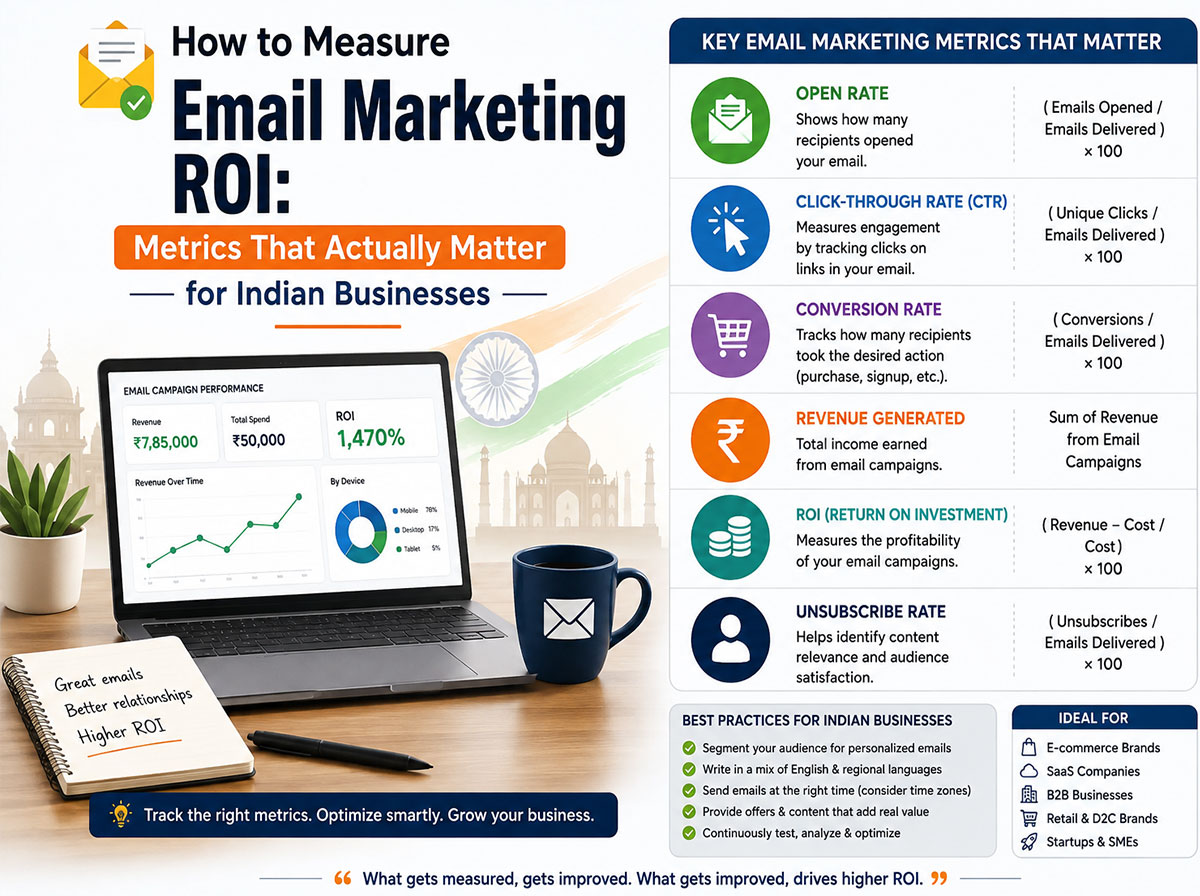
ROI = (Revenue Generated - Campaign Cost) / Campaign Cost × 100
Let’s understand this with an example.
Suppose you have an online clothing brand in Pune. Your email campaign generated Rs. 1,25,000 in revenue, and you spent Rs. 4,500 on marketing. Let’s calculate the ROI using the same formula.
ROI = (1,25,000 - 4,500) / 4,500 × 100 = 2,677.78%
This means that for every Re. 1 spent, you made Rs. 26.78 in profit, which is an excellent email marketing ROI.
Formula 2: Revenue Per Email (RPE) and Revenue Per Subscriber (RPS)
ROI tells you the overall profitability, but RPE and RPS tell you how much revenue each email and subscriber generated.
RPE: Total Email Revenue / Total Number of Emails Delivered
RPS: Total Email Revenue / Total Number of Active Subscribers
Let’s calculate RPE. If you sent 10,000 emails, your RPE = Rs. 1,25,000 / 10,000 = Rs. 12.50.
So, each email generated an average revenue of Rs. 12.50.
RPS for 5,000 subscribers = Rs. 1,25,000 / 5,000 = Rs. 25.
Each subscriber generated Rs. 25 in revenue on average.
However, for accurate email marketing ROI, you must consider other hidden costs, such as GST, lead magnets, landing page tools and list-cleaning tools.
Why You Should Track Email Metrics
When a business in India builds and launches an email campaign, it wants to see the results. These results can be measured by tracking a few essential metrics that we will discuss below. But most businesses either overlook the importance of email marketing metrics or they just don’t know why it is essential to track them.
Well, tracking these metrics is important because it gives you answers to the three most important questions:
- Is my email reaching people?
- Are people interested in my email?
- Am I making money from it?
If you are not tracking, you are just guessing. If your email campaign fails, you will never know what happened. Was it the subject line? Was it the offer? Metrics let you identify the reasons and fix the issues efficiently. If you find tracking all this confusing and difficult, a proper analytics and reporting setup can show you everything in one simple dashboard.
ROI Is the Business Metric You Must Track
Apart from this, what you should know is that email marketing ROI is also a metric. In fact, it is the most important metric you must track. Most businesses think that metrics are technical terms like “open rate” and “CTR,” but ROI is a business metric.
The common email metrics tell you how your email campaign is performing, but business metrics tell you how your business is performing because of email marketing.
ROI is the most important metric. It connects your email marketing to your bank account.
Let’s understand this with an example.
You send 1,000 emails, and the open rate shows 50%, which is amazing. But you have 0% ROI, which means you earned nothing from the campaign.
On the other hand, you have only a 10% open rate, which is low, but you have 50% ROI because customers bought from the campaign.
At the end of the month, you won’t calculate how many people clicked on the link (CTR). You will see how much money your business makes. However, every metric plays an important role in tracking the performance of your campaign. Most businesses make the common mistake of tracking everything. Tracking 15-20 metrics can confuse you. Instead, you should track only a few essential ones, as discussed below.
Email Marketing Metrics That Actually Matter for Indian Businesses
You might have read several blogs on important email marketing metrics and KPIs to track. But tracking everything is neither possible nor logical. Here are the most important metrics that actually matter for Indian businesses and that you must track to know what you need to fix.
Open Rate: How Many Recipients Open Your Email?
One of the most common and obvious metrics that every business owner looks at when reviewing the success of their B2C or B2B email campaign is the email open rate. This indicates how many people received and opened your email. If you have higher open rates, this means your email subject line was compelling enough to grab the customer’s attention.
Open Rate = Opened Emails / Delivered Emails × 100
Calculate the open rate of your email campaign using this formula. An Indian benchmark of 25-35% is generally considered good for open rates. During festive seasons, such as Diwali and Dussehra, the rate can go higher.
However, you should not rely on open rates alone because factors such as the recipient’s email client, time of day and privacy features can affect the metric. Also, higher open rates don’t necessarily mean more conversions.
Click-Through Rate (CTR): How Many Clicked?
CTR tells you how many people clicked on the link inside the email. This is an indicator of how successful your email was in prompting action. But it tells you, out of everyone who received the email, how many people actually clicked. This is different from CTOR (Click-to-Open Rate).
CTR Formula: Clicks / Delivered Emails × 100
CTOR Formula: Clicks / Opened Emails × 100
If the CTR is high, it signals that your emails are good and resonate with recipients. But if it is low, this means your email has a problem somewhere in the process. Either the calls to action (CTAs) are not compelling enough, or they are not well positioned. A 2-3% CTR is a good benchmark for Indian businesses.
Conversion Rate: How Many Bought?
It is one of the most important metrics to measure your ROI because it tells you how many people actually took a desired action after clicking on the link. From signing up for a webinar to making a purchase or downloading a guide, conversion rate tells you whether your email campaign is driving value for your business.
Conversion Rate Formula: Number of Purchases / Emails Delivered × 100
Conversion rates of 1-2% are a solid benchmark for Indian businesses, but if it’s above that, then it is excellent.
Bounce Rate: How Many Emails Fail to Reach?
This metric measures how many emails fail to reach the recipient. This can happen for several reasons, but two common ones are hard bounces and soft bounces.
0.3-0.7% is a typical indicator across the industry. Having a bounce rate higher than this can indicate issues with the quality of your email list and even technical problems with email deliverability. Hence, maintaining a clean and updated email list is crucial for improving email deliverability and reducing the bounce rate.
Revenue Per Email (RPE): Value of One Email
Open rates and click rates tell you how people are engaging with your emails, but RPE shows the real value of your email campaign. It shows if your campaign is generating real revenue. It is important because it makes decision-making very easy. You will know exactly how much you make from every single email. It is like the price tag of one email in your list.
Unsubscribe Rate: How Many People Left?
It is quite common to lose subscribers over time. But if you are facing a sudden spike in unsubscribe rates, there is probably a bigger underlying issue you are overlooking. If more subscribers are leaving, this means your content is not resonating with your audience.
A good unsubscribe rate is 0.5%. If it goes above 1%, either you are sending too many emails that are annoying recipients or sending irrelevant emails that subscribers aren’t interested in.
Therefore, you should always segment your email list so you can send more relevant emails to prospects based on their preferences, behaviour and stage of the customer journey.
Spam Complaints: How Many Marked You as Spam?
What is a spam complaint? When someone hits “Report Spam” instead of “Unsubscribe,” your email is treated as spam. This affects your sender reputation. If your spam complaint rate goes above 0.1%, Gmail and Yahoo may start putting your future emails in the spam folder because they have strict requirements for senders. The ideal benchmark for Indian businesses is 0.1-0.5%. If you are above this, you are in danger.
Forwarding Rate: How Many Shared Your Email?
One of the easiest and most effective ways for Indian businesses to grow their audience is through family and friend recommendations. So, you should track the forwarding rate to know how often people have shared your emails. A higher forwarding rate means your email is valuable and interesting enough that people are actively sharing and recommending it to their friends and family.
There is no good standard rate for this because even a 1-2% rate is excellent. This metric is helpful for businesses that want to grow organically because emails shared by recipients can bring in more leads and potential customers.
Conclusion
We know that businesses in India prefer online advertisements, especially Instagram and Facebook ads. But let’s be honest: running ads is getting expensive day by day. Also, it is not the same as before. Even on e-commerce portals, no one shares the customers’ details with you, making it almost impossible for you to reach the same customer again.
Email is different. It is the only platform where you own your subscribers. The customer is yours. You have their email address and other relevant information. You can communicate with them without paying extra charges. This is why email marketing ROI is still higher than other modes of marketing.
You don’t need to be an email marketing expert. Just ask a few questions after every email you send, and your metrics will tell you what exactly to fix.
However, we suggest you don’t try everything at once. Begin with only 100 emails and gradually increase the numbers. And most importantly, invest in good email analytics tools in India.
Ready to send campaigns that convert?
Try ASP OL Media free for 14 days — no credit card required.