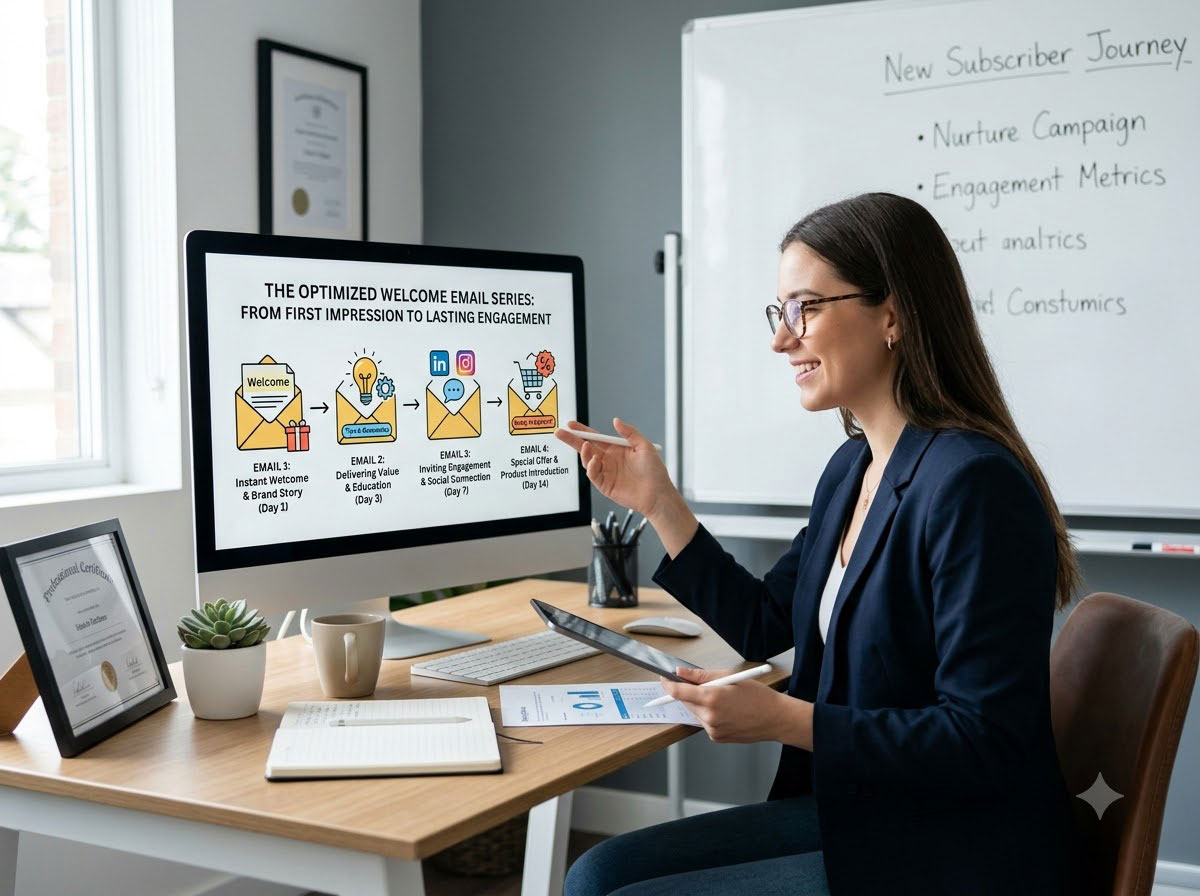
Welcome Email Series: First Impressions to Keep New Subscribers Engaged
The first email is important. First impressions last a long time. When someone joins your email list, they are giving you a little bit of their time and attention. Maybe they read a blog post, downloaded something, grabbed a discount, or simply thought your emails might be useful later. Either way, you’ve got their attention for now, and that’s not something to take for granted.
Do not waste it. What happens next can determine if that person becomes a regular reader or quietly forgets why they signed up in the first place, which is exactly why a welcome email series deserves more thought than a single automated “Thanks for subscribing” message.
A welcome series gives you room. Instead of cramming your story, offer, benefits, links, and sales pitch into one crowded message, you can spread the conversation across several emails and give each one a clear job. That makes the experience easier to follow and gives subscribers a reason to open the next message.
So, what should you send?
The answer depends on your business, but the basic idea stays fairly simple: welcome people, give them something useful, show them what they can expect, earn some trust, and only then ask for a bigger action.
What Exactly Is a Welcome Email Series?
In simple words, a welcome email series is a planned sequence. A welcome email series is a group of automated emails sent after someone joins your list, signs up for a service, downloads resources, or takes another action that puts them into your email programme, with each message designed to move the relationship forward rather than repeat the same greeting.
Think of it as an introduction. You wouldn’t meet someone at a networking event, shake their hand, shout your entire company history at them, and immediately ask for a purchase, so your email marketing probably shouldn’t work that way either.
Let people breathe. The first message can be a welcome email. The second one can be an email explaining what you do. The third one can be a useful content email. The following emails can be product introductions, proof, or a logical next step. You don’t want to corner your subscriber.
That’s the real advantage. You’re building familiarity slowly. And familiarity matters because a subscriber who knows your name, knows your value and knows what your emails are typically about has far less reason to hit the unsubscribe button.
Why New Subscribers Deserve Special Treatment
New subscribers are paying attention. They have just shown interest, which means the subject, offer, article, or sign-up form that brought them to your list is still fresh in their mind, and their curiosity is usually stronger than it will be several weeks later. Kajabi describes this period as a peak-interest moment for new subscribers.
That window is not going to be open forever. Wait too long, and your email may show up in their inbox like a message from a stranger, especially if the subscriber signed up for your list for one specific download or offer instead of a long-term relationship with your brand.
Timing is key here. Send the first welcome email right away; the other messages can be spread out over a few days so the subscriber gets information without being overwhelmed by a sudden flood of marketing emails.
The first email should feel like it is expected. It’s more important than fancy design because you want people to know right away why they got the message, what they signed up for, and what they should do next.
Email One: Say Hello Properly
You should start your first email with a simple, friendly greeting. For instance, you can thank them for signing up, remind them what they signed up for, and give them whatever you promised. But don’t write a lengthy email; people won’t dig through a long email to get what they came for.
Keep your email simple. If you promise them a guide, give it to them. If you promise them a coupon, put the coupon where it is obvious, not buried under three screens of brand history.
Don’t make subscribers work hard. A short welcome, a useful resource, and one clear action can be enough because the subscriber doesn’t need your entire marketing strategy on the first date.
Make the next step obvious. You might ask them to read a useful article, explore a popular resource, complete a profile, reply to the email, or simply keep an eye out for the next message.
Email Two: Explain What They Joined
In the second email, give some context. This email can tell people who you are, what you stand for, what kind of content they can expect and why it might be useful for them to stay on your list. You must not add another stream of promotional messages to their inbox.
Show your personality rather than a corporate biography that starts with the year your company was founded and somehow takes twelve paragraphs to reach the point.
Tell the useful story. Explain the problem you solve, why you started solving it, what makes your approach different, or what subscribers can expect to receive from you over the coming weeks.
Also, set expectations early. Tell people how frequently you intend to email them and what type of material they will receive, because setting clear expectations can help reduce confusion and protect the relationship you’re attempting to build.
Don’t make promises you can’t keep. If you say subscribers will receive one useful email every Tuesday, sending four sales messages before Friday will make the original promise look rather silly.
Email Three: Give Them Something Useful
The third email should earn its place. After saying hello and explaining your brand, give subscribers something they can actually use, because useful information creates a much stronger reason to keep opening emails than repeatedly reminding people that your company exists.
Teach them something little. For instance, you can share a checklist, explain a common mistake, give a practical tip, point them to a helpful resource, or show them how to solve a problem related to the reason they joined your list.
Do not push too hard. If every sentence ends with “Buy now,” subscribers will notice, and the conversation may become less helpful and more like someone standing next to you holding a sales brochure.
Value should come first. That doesn’t mean you can’t sell in a welcome series, but the subscriber should know why your emails are worth their attention before you ask them to spend money. Give them a reason to return. The best welcome emails make the reader think, “That was actually useful,” because that thought creates a much stronger habit than any other discount code ever could.
Email Four: Let Others Do the Talking
Trust requires evidence. You can tell your subscribers that your product works, your service saves time, or that your team knows what it’s doing, but those claims are far more convincing when customers, clients, readers or users can tell the same story from their own experience.
Social proof is helpful. A short customer story, testimonial, review, case study, result, or example that directly relates to the reason the subscriber joined your list. Make it believable. A testimonial that reads like it was written by a committee of twelve marketing executives usually does less work than a simple customer comment that tells what changed after using your product.
Specific details also matter in your email; “great service” says nothing. A brief story that outlines a problem, a solution and a resolution gives the reader something tangible to evaluate. Don’t use proof to exude confidence. Let the data speak for itself, then give the subscriber a natural way to learn more if desired.
Email Five: Make a Request
You can ask in the fifth email. The subscribed user has now received a welcome, some background information, and some helpful details. They may have some evidence that others have benefited from what you have to offer, so a stronger call to action appears to be a reasonable next step rather than an ambush.
Keep the action focused. You could invite them to schedule a consultation, begin a trial, browse a product category, join a webinar, read a detailed case study, or make their first purchase.
One action works better. If your email contains seven buttons shouting for attention, the subscriber must decide which one is important, and many people will solve this problem by doing nothing at all.
Make the decision easy. For example, the CTA should tell people exactly what happens after they click, whether that means “Book a 15-minute call,” “See the pricing,” “Read the case study,” or “Start your free trial.”
That small detail matters. People are a lot more likely to click if they know exactly what they’re going to. That is, if the destination is predictable and relevant to what they’ve been reading.
Don’t Make Every Email a Sales Pitch
This is an easy mistake to make. A company gets a new subscriber and immediately starts thinking about how to turn that person into a customer. Before long, the welcome series is packed with discounts, product links, countdowns, and messages saying an offer is ending tonight. Then another email arrives the next day with another “final” offer.
Most people find it tiresome pretty quickly. Maybe someone signed up for information that was useful to them or just because they wanted to learn more about the company. That doesn’t necessarily mean they’re ready to buy. Treating every new subscriber like a ready-to-convert lead can make the relationship feel forced from the beginning.
Give them some time and let interest develop. The better approach usually combines useful content, brand information, proof, and relevant offers so subscribers can decide whether your company deserves more of their attention.
People aren’t complicated here.
They simply want to know what’s in it for them, whether they can trust you, and whether opening another email from you will be worth the time. Give them good reasons. A welcome series works best when the commercial message grows naturally from the value you’ve already provided instead of appearing out of nowhere.
Write Welcome Emails That Feel Personal
Many email marketers write emails in a corporate tone; you must not. Forget it and write the welcome email in a way that it looks like a real person talking to another person. Keep the language simple, use contractions, and write the way you’d actually speak. It should feel like you’re talking to the reader, not dropping them into a generic template.
Use “you” often. Instead of writing “Our company provides customers with innovative solutions,” try explaining what the subscriber can actually do, save, learn, fix, or achieve with your help.
There’s a big difference. The first sentence talks about you, while the second starts with the person who has to decide whether your email deserves another thirty seconds.
Read it aloud. If the email sounds awkward when spoken, it probably needs another edit, especially when several sentences contain words nobody would use during an ordinary conversation.
Keep the personality intact. Your welcome series should sound like the same company people encountered when they first decided to subscribe, because a sudden shift into stiff marketing language can make the relationship feel artificial.
Personalisation Should Feel Natural
Personalisation has its limits. If you add the first name of the subscriber to the subject line, it can be helpful, but real personalisation is more than just the first name. It uses information about where they signed up, what they downloaded, what they clicked on, what they purchased or even what interests they expressed in their interaction with your brand.
Don’t get creepy. Nobody needs an email announcing that you noticed they visited three product pages at 11:47 PM while sitting on a particular device.
Use useful signals. If someone downloaded a beginner’s guide, their next email should probably help them take the next beginner-friendly step rather than immediately pushing an advanced product designed for experienced users.
That feels relevant. Segmentation can make the series much more useful because different subscribers often arrive with different needs, expectations, and levels of buying intent. Start with what you know. Even one meaningful difference between subscriber groups can make the next email feel far more relevant than sending the exact same sequence to everyone.
Welcome Email Design Best Practices
Pretty emails aren’t automatically good emails. A welcome message can contain beautiful graphics, clever animations, multiple content blocks, six buttons, social icons, product cards, and enough visual decoration to resemble a small website, yet still fail because the reader can’t quickly figure out what the email wants them to do.
Clarity wins here. The design should help the reader move through the message, especially on a phone, where crowded layouts, tiny text, oversized images, and awkward buttons can turn a simple email into a frustrating little puzzle. Act-On specifically recommends keeping welcome emails mobile-friendly and concise.
Make the main point easy to spot. Use lots of space around the important stuff. Keep paragraphs short. Make links obvious. Don’t make readers walk a decorative obstacle course to get to the useful stuff. And test the actual email. Open it on a phone, check the links, look at the images, test the CTA, and make sure the message still makes sense if images don’t load.
Small problems become big problems. A broken button in the first email can make a polished brand look surprisingly careless, especially when the subscriber has no reason to trust you yet.
Ensure One Clear Goal for Each Welcome Email
This rule saves a lot of trouble. When an email tries to welcome, educate, introduce the company, sell a product, collect preferences, promote social accounts, explain a loyalty programme, and announce a webinar all at once, the subscriber has to sort through your priorities before deciding what matters.
Give each email a clear job. One email may be the resource you promised. Another can tell you what subscribers can expect from you. Then give something really useful, add in a customer story or other proof and mention the product or offer when it makes sense. That makes the sequence easier to manage. You can get a better sense of what’s working. You’ll see which emails people open, which ones get clicks, and where subscribers start dropping off.
Simple beats crowded. A focused email gives a clear path to the reader, whereas a crowded one leaves several half-finished paths competing for attention.
Ask yourself one question. If the subscriber remembers only one thing from this email, what should that thing be?
Measure Welcome Email Performance
A welcome series needs attention after it goes live. Once people start receiving the emails, their behaviour will tell you a lot about what works and what doesn’t. Track opens, clicks, replies, unsubscribes, purchases and other actions. ASP OL Media recommends testing both content and send timing instead of assuming the original setup will always work.
Don’t rely too heavily on open rates. Apple Mail Privacy Protection makes open data less reliable. So clicks, replies, conversions, website visits and purchases can give you a better idea of how subscribers are responding.
Test one thing at a time. When you test the sequence, modify one element at a time. Try a new subject line, CTA, send delay, opening paragraph or content angle, then compare the results. It is much harder to know what really made a difference when you change several things at the same time.
Pay attention to unsubscribes too. A high unsubscribe rate after one particular email may tell you that the message is too promotional, poorly timed, irrelevant, or simply different from what people expected when they joined.
Your subscribers are giving feedback. Sometimes they use a reply, and sometimes they simply stop opening your messages, but both signals deserve attention when you’re trying to build a list people actually want to hear from.
Common Welcome Email Mistakes to Avoid
Do not send five identical emails. A sequence requires movement. And if each message contains the same offer with slightly different wording, subscribers will have little incentive to open the next one.
Don’t hide the unsubscribe link. Marketing emails need a clear way for people to leave, and making the process difficult doesn’t create loyalty; it usually creates frustration and can hurt list quality and sender reputation.
Make the first email simple. Someone who just signed up on your list doesn’t need twenty links, three offers, a company history, five social profiles, and a seven-paragraph explanation of your philosophy before they can get what they wanted.
Think of the original promise. If you have someone sign up for SEO tips and you’re sending them product promos every other day, you’re going to have a very quick mismatch between expectation and experience. And don’t disappear. A welcome series should connect naturally with your regular email programme so the subscriber doesn’t receive five thoughtful messages during the first week and then hear nothing for the next two months.
How Many Emails Should a Welcome Series Have?
Frankly speaking, you don’t need twenty emails. For many businesses, a sequence of four or five messages provides enough room to welcome the subscriber, explain the brand, provide value, establish credibility, and introduce an appropriate next step without stretching the introduction beyond its useful life. Act-On’s current example uses five emails spread across roughly seven to ten days.
Schedule is subject to change. A SaaS company, e-commerce store, newsletter publisher, consultant and travel business may all need different timing because their subscribers have different expectations and buying cycles. Start with a reasonable structure. Send the welcome right away, then give useful context a day or two later, offer deeper value, introduce proof, and then make a relevant offer once the subscriber has enough information to make a sensible decision.
Then watch the data. If people are really engaged with email two but then drop off after email four, that’s something that you should investigate, not ignore. Your first version doesn’t need perfection. It needs a clear purpose, useful content, sensible timing, and enough flexibility to improve once real subscribers start telling you what works.
How to Ensure the First Impression Keeps Working
A welcome email is deceptively simple to underestimate. While it might be a small automated message running in the background, those initial few emails can be the lasting impression of how your subscribers view your company. They set the tone for what people can expect from you in the subsequent emails.
That’s why the welcome email series is important. You’re not just launching a brand. You show subscribers what your emails will look and feel like, what they will get, how often you will be in touch, and whether it’s worth their time to open your next message.
Keep it human. Welcome people quickly, give them something useful, describe what they signed up for, and present credible proof. Plus, make a single clear request and let the relationship develop without trying to squeeze every possible conversion out of the initial week. That’s a better first impression. And when the subscriber begins looking forward to your next email instead of wondering how to get off your list, you’ve done something far more valuable than simply getting another address into your database.
You’ve earned attention. That’s the part worth protecting, because an email list only becomes genuinely useful when the people on it choose to keep listening.
Ready to send campaigns that convert?
Try ASP OL Media free for 14 days — no credit card required.