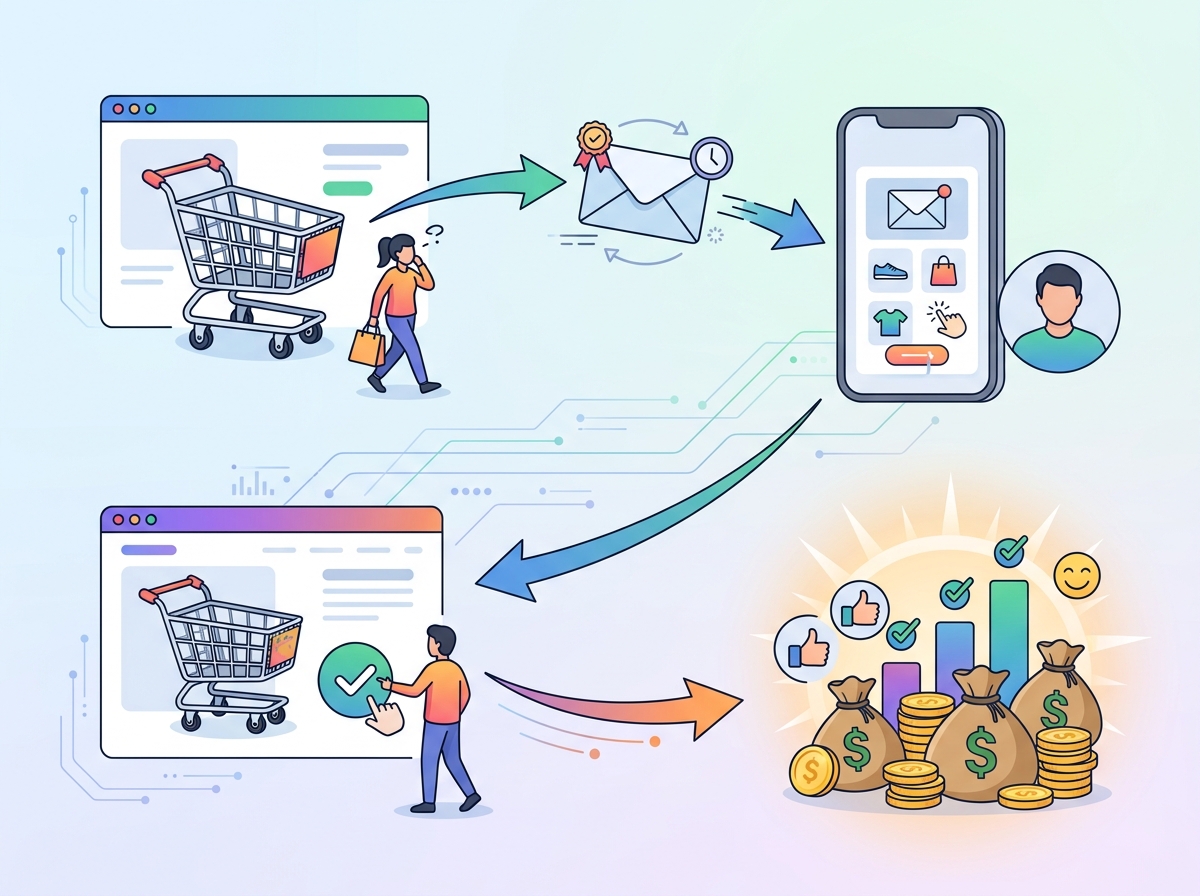
Strategies to Recover Abandoned Carts and Increase E-Commerce Sales
Cart abandonment costs lakhs to e-commerce businesses every day. But the good news is that you can easily convert a few of those lost sales with just 3 automated emails.
Imagine a customer added a Rs. 1,000 dress to the cart on your online store. She got excited, but at checkout, she saw Rs. 200 in extra shipping charges. She simply closed the tab and moved on.
This happens most of the time with online businesses. However, most e-commerce merchants do not realise that the customer did not say no, but "not right now." And this is where you need to use email marketing.
In this guide, you will learn how email marketing helps e-commerce businesses recover abandoned carts and boost sales. You will learn how to bring back such customers through email marketing.
We will break down:
- The psychology behind abandoned carts so that you can fix the real problem.
- 3-email sequence that actually helps recover abandoned carts
- Tactics that make the email sequence work.
The Real Reasons People Abandon Carts
An abandoned cart isn’t rejection, but hesitation. Before buying a product, a customer is not sure about their decision. They might want to explore more similar options at lower rates, find another size/shade/brand or simply not be interested in buying now.
Customers usually browse multiple shopping apps and websites initially. So, if they have left the item in the cart, it’s not you; it’s the psychology. During online shopping, shoppers encounter invisible barriers to conversion. If you understand these barriers, you can fix the real problem and increase conversion and revenue with email marketing.
Unexpected Costs at Checkout
One of the most common reasons for abandoned carts is the price shock people face at checkout. People hate losing money more than gaining a product. When taxes, extra shipping charges or fees appear during checkout, the brain considers it a sudden loss. As a result, people abandon carts.
For example, someone added a pair of shoes worth Rs. 1,999 to the cart. But the checkout shows Rs. 2,499 with shipping. The customer immediately abandons the cart, finding it a significant loss. This gives a feeling of “it costs more than I expected”, hence, they leave.
Your email strategy for this should include sending a follow-up email highlighting free shipping, transparent pricing or limited-time delivery offers.
Complicated Checkout Process
Another common reason is the complicated checkout process that customers go through. They instantly feel tired. Long checkout forms, account creation requirements, multiple verification steps and too many decisions increase effort.
When buying starts to feel so complicated, customers postpone their buying decision and often never return.
For example, a customer buying a T-shirt needs to create an account, enter OTPs and fill multiple fields. They leave immediately after reaching checkout because they find the process too complicated.
Fear of Making the Wrong Purchase
Buying a product online is a crucial decision without testing the product. It’s virtual shopping where people cannot touch, try or test. The brain overestimates the risk of buying a bad product to protect itself. They instantly start questioning themselves: "What if I regret buying this product?"
This is the most common reason people often abandon carts. However, if at the same time they get some help, such as customers’ positive experiences, your job is to give them proof that they won’t regret buying the product.
Customers abandon carts because they are unsure about the size, fit, colour and quality. Through follow-up emails, you can build confidence.
Exploring Better Option
Sometimes customers delay their decision not because they dislike the product, but because they want to explore more options. They leave because they want to see better alternatives before making the final decision. They compare rates, reviews, discounts and features across multiple apps and portals to ensure they are buying the right product.
For example, a customer adds a smartwatch to the cart but opens several tabs to compare the same product on different e-commerce websites. During this process, they either get distracted or simply forget to return.
This is where email marketing helps. E-commerce businesses can send reminder emails to customers showing the product’s image, selected variations, ratings and other benefits. This reminds them why they were interested in the product in the first place and encourages them to return.
Delaying the Purchase Decision
Many customers abandon carts simply because they do not feel the need to buy the product immediately. It is possible that they were interested initially but intend to buy it later. Due to this, the decision gets delayed, and eventually, they forget.
Customers often think, “I will buy it tomorrow,” or maybe when there is a deal offered by the brand. However, delayed decisions often turn into missed purchases.
For example, a customer adds a wireless headphone to the cart and plans to order it later, but after a few days, they forget about it completely.
In this situation, businesses send follow-up emails that help them bring those customers back. Limited-time offers, low-stock alerts, faster delivery and timely reminders can encourage customers to complete their purchase without delaying it further.
The Email Sequence that Actually Converts
To encourage customers to buy the products they have in their cart, e-commerce businesses can send abandoned cart emails. Instead of immediately offering discounts and promotional deals, many brands follow an email sequence to send 2-3 follow-up emails over a few days, each with a different purpose.
A well-planned email sequence helps e-commerce businesses re-engage interested customers and turn abandoned carts into completed purchases.
Here is an abandoned cart email sequence that helps businesses recover lost sales
Email1: Reminder
After a few hours, businesses can send an abandoned cart email to remind customers about the products they left in the cart. Not every time customers leave products in their cart intentionally; sometimes they may get distracted, compare options, face unexpected costs or simply postpone the purchase.
The purpose of this email is to re-engage with customers and remind them to complete their purchase.
For example, send an email with the subject line “Hey Sam, you left something behind”. Include the product image, prices and a ‘Complete Checkout’ button inside the email. Additionally, you can highlight limited stock availability to encourage quick action.
This reminder encourages customers to quickly return to their cart and complete their purchase.
Email 2: Follow-up Email
24 hours later, businesses should send another email to address customers’ queries and clear their doubts. Many customers add a product to their cart but may doubt whether the product is worth the price or whether they really need it.
The purpose of this email is to address doubts and boost confidence to help customers complete their purchase, ‘complete your order before items go out of stock’.
For example, send an email with the subject line, “Still thinking? Your cart is waiting”. Inside the email, include customer reviews and ratings. Besides, you can add free shipping offers and FAQs about “Why customers love this". Additionally, add urgency by mentioning, “Your cart is saved, but the items are selling fast”.
Email 3: Incentive/Offer
If recovery still doesn’t happen, you should try offering an incentive.
For example, send an email after 48-72 hours for the last push with an offer. The subject line should be ‘Free shipping expires tonight’ or ‘We saved your cart plus 10% off’.
This is a discount email that attracts customers and encourages them to complete a purchase. However, you should not always lead with discounts, or else people will always abandon waiting for one.
7 Tactics That Make This Email Sequence Work
Sending abandoned cart emails alone does not guarantee the customer will return and complete their purchase. Timing, content, design and the overall user experience together play an important role in influencing buying decisions.
E-commerce businesses follow an email sequence that does more than just remind customers about an incomplete purchase. It encourages action by making the checkout process relevant, convenient and worthwhile.
Here are the proven tactics that make the email sequence work better to convert more abandoned carts into sales:
1) Write Subject Lines that Encourage Opens
You might have heard this a million times that the subject line of an email determines whether a customer will open it or ignore it. But this is a fact. You should know that if your subject line does not spark curiosity, the recipient will probably ignore the email.
Therefore, you must pay attention to the subject line while designing the email. Instead of keeping the message generic, include the words that remind customers about what they left behind and encourage them to return.
For example, “Complete your purchase” is a bad subject line. Customers simply ignore such emails. Instead, write, ‘Your Samsung Galaxy is waiting in your cart’, ‘Your Wildcraft backpack is waiting’ or ‘Did you forget something?’.
For personalisation, use the customer’s first name and the product name.
2) Show the Actual Product
As discussed above, the subject line sparks curiosity, but you must keep it relevant to their abandoned cart. Inside the email, you should display the real image of the product the customer was interested in.
Showing the image immediately reminds customers what they were searching for and have kept in their cart. Use the best-quality images, and mention the name, price and variants in colours and sizes. Make them visualise using the product. To make it relevant to recipients’ needs, personalise the subject line.
For example, ‘Your men’s sneaker, size 9, is still in stock’.
3) Provide a Clear CTA Button
Follow-up emails alone won’t work if there is no clear action button for customers. Assuming that only reminding customers about the incomplete purchase would be imprudent. Don’t make your customers hunt for the product. Instead, add a button “Complete My Order” or “Return to Cart”. Link them directly to their pre-filled cart.
4) Address Purchase Barrier
There are many reasons a customer leaves products in their cart. It could be related to pricing, reviews or simply saving it for later. This means the customer is still in exploration mode and not completely ready to buy.
You must understand what could be the reason for abandoning carts and later use follow-up emails to offer solutions.
For example, you can offer free shipping to encourage them to complete the purchase: “Complete your order today and enjoy free shipping”. You can also include other offers, like easy returns, secure payment options or cashback.
5) Build Trust with Customer Reviews
Not only pricing concerns, but trust issues are also one of the common reasons customers do not proceed to purchase and keep items in the cart. So, you will have to remove their hesitation by showing social proof, which boosts their confidence and improves conversions.
Add ratings, testimonials or customer reviews, which help customers know that other customers had a positive experience with the product. This will clear their doubts and ultimately encourage them to buy the product.
6) Create Genuine Urgency
You can encourage faster conversion by using genuine urgency. Using fake information to manipulate customers can hurt their sentiments. Hence, it is crucial to use genuine urgency to recover abandoned carts and boost sales.
For example, if a customer has added a Polo T-shirt to the cart, you should send an email highlighting the limited stock availability. Such as “Low Stock: Only 3 Left” or “Hurry up! The Deal Ends Today”.
7) Make Customer Support Easy to Access
No matter how many follow-up emails you send, customers may remain confused about the product, and it is obvious for many reasons. You will have to ensure that you are always there to help in any case of confusion, doubts or trust issues. In your email, provide a quick way for customers to ask any questions before purchase.
For example, you can say, “Have questions? Reply to this email—we are here to help”.
Final Thoughts
Customers abandoning carts does not always mean they are no longer interested in buying products. In many cases, they are either distracted, want to compare rates, explore better options, delay their decision or need more confidence before completing the purchase.
This is where email marketing helps e-commerce businesses to recover abandoned carts and boost sales. However, it is important to use the right email sequence, personalised messaging, timely follow-ups and customer-focused communication. Only then can businesses encourage shoppers to return and complete their purchase.
Make sure you focus on removing the barriers that are stopping customers from purchasing in the first place. Use a well-planned abandoned cart email strategy as discussed above to recover more sales for your e-commerce business, as well as build better customer relationships over time.
Ready to send campaigns that convert?
Try ASP OL Media free for 14 days — no credit card required.